How Is Mechanical Vapor Recompression (MVR) Used Across Different Industries?
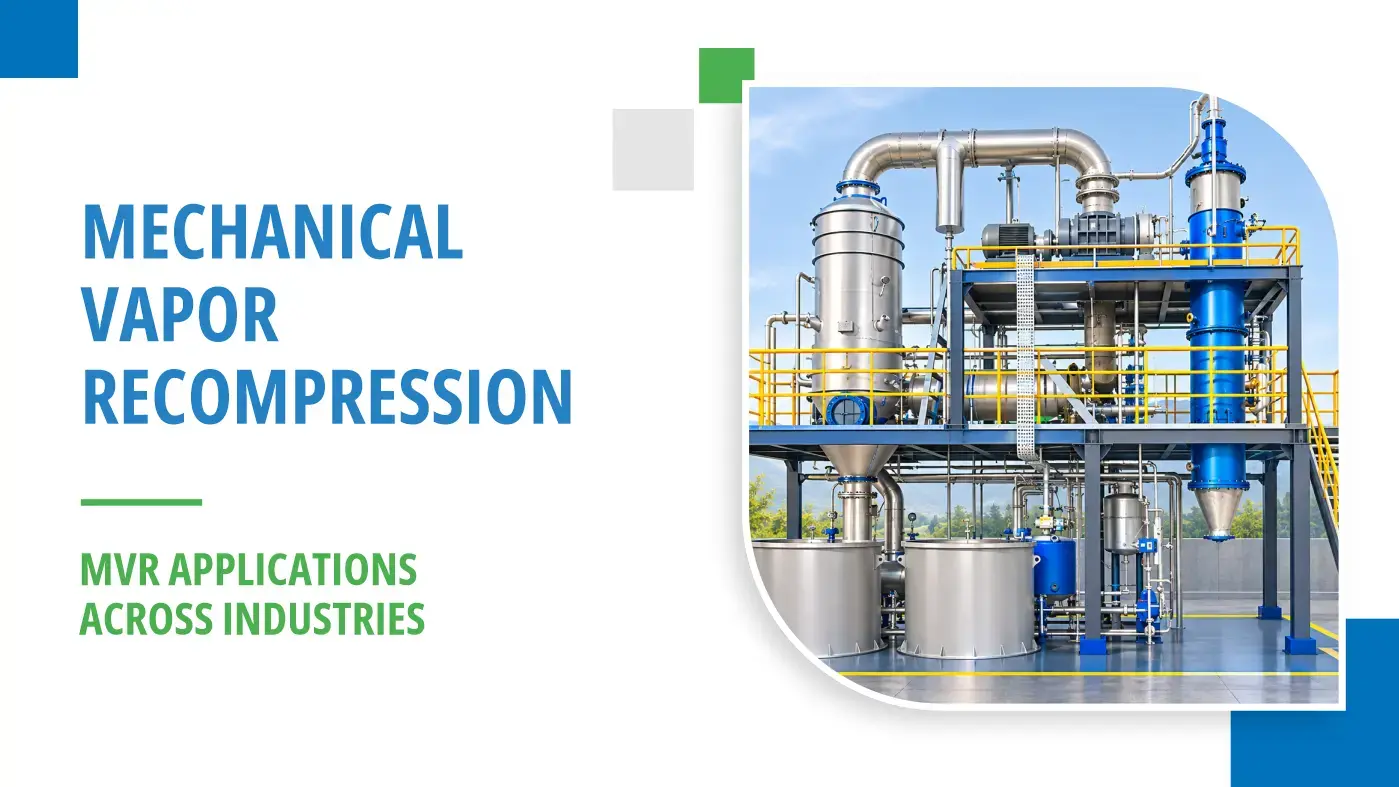
Mechanical Vapor Recompression (MVR) is an energy-efficient evaporation technology used for liquid concentration, thermal energy recovery, and wastewater volume reduction. It compresses the secondary vapour generated during evaporation and reuses it as a heating medium, reducing dependence on external steam during normal operation.
MVR is used in chemical, pharmaceutical, agrochemical, textile, battery, food, dairy, and industrial wastewater applications. Depending on feed characteristics and treatment objectives, it can be integrated with Multi-Effect Evaporators (MEE), forced circulation systems, reverse osmosis (RO), and downstream crystallisation or drying equipment.
What Is Mechanical Vapor Recompression (MVR) Technology?
MVR is a thermal evaporation process that recovers the latent heat in generated vapour. In conventional evaporation, external steam supplies much of the heat required to evaporate water or another suitable volatile component. In an MVR system, secondary vapour passes through a mechanical compressor, which raises its pressure and saturation temperature. The compressed vapour then transfers heat through the evaporator's heat-transfer surface and condenses, releasing energy to the process liquid.
This creates a continuous vapour-recirculation loop and reduces fresh steam demand. External steam may still be needed during startup or under specific operating conditions.
How Does an MVR Evaporator Work?
An industrial MVR evaporator generally operates through these stages:
- Feed preparation: The process liquid is filtered, pretreated, or preheated as required.
- Evaporation and separation: Heat causes the volatile component—typically water—to evaporate. A vapour-liquid separator separates secondary vapour from the concentrated liquid.
- Mechanical compression: The compressor increases vapour pressure and temperature.
- Heat recovery and condensation: The compressed vapour transfers heat to the process liquid and condenses.
- Recovery and discharge: Condensate is collected for quality assessment and potential reuse. Concentrated liquid proceeds to further concentration, crystallisation, or other downstream processing.
External heating steam may be required during startup, while auxiliary heating may be necessary under specific operating conditions. However, the compressor increases the vapour pressure and saturation temperature, allowing the vapour to transfer heat back to the evaporator.
They are distinguished by:
- MVR compressor: Recompresses secondary vapour for heat reuse.
- Condenser/heat-transfer surface: Transfers the recovered thermal energy to the process liquid.
- Vacuum system: May remove non-condensable gases and support pressure control, depending on the configuration.
What Are the Major Components of an Industrial MVR System?
An industrial MVR installation consists of interconnected thermal, mechanical, and process-control equipment.
|
Component |
Primary function |
|
Vapour compressor |
Raises secondary vapour pressure and temperature |
|
Evaporator heat exchanger |
Transfers thermal energy to the process liquid |
|
Vapour-liquid separator |
Separates vapour from concentrated liquid |
|
Feed and circulation pumps |
Supply feed and maintain liquid circulation |
|
Condensate collection system |
Collects condensed vapour for potential recovery |
|
Vacuum and gas-removal system |
Maintains operating pressure and removes non-condensable gases where required |
|
Instrumentation and control panel |
Monitors temperature, pressure, flow, level, and operating conditions |
The compressor is generally the main electrical energy consumer. Its selection depends on vapour flow, compression ratio, inlet conditions, required temperature lift, and operating range.
Mechanical Vapor Recompression (MVR) is an established energy recovery technology used in industrial evaporation. The MVR technical guide published by New Zealand's Energy Efficiency and Conservation Authority (EECA) explains how recompressed vapour can be reused as a heat source in evaporation, distillation, and drying processes.
How Is MVR Technology Used Across Different Industries?
MVR technology can be applied to industrial processes where evaporation is required for concentration, water recovery, and waste volume reduction. The equipment configuration depends on feed composition, thermal properties, viscosity, fouling potential, and the required recovery level.
1. Chemical Industry
Chemical plants may generate process liquids and wastewater containing dissolved salts, inorganic compounds, acids, alkalis, and other constituents. MVR can be used for:
- Concentrating compatible aqueous chemical solutions and inorganic salts.
- Recovering water from suitable process wastewater and high-TDS effluents.
- Treating selected RO reject streams.
- Integrating with MEE and ZLD systems.
For example, a plant generating saline wastewater may use pretreatment followed by MVR evaporation to recover condensate and concentrate the brine. Condensate may require further treatment before reuse; the concentrate can proceed to crystallisation or other solids-handling equipment.
Engineering considerations: Boiling point elevation, corrosion, and scaling affect evaporator configuration, heat-transfer design, material selection, and operating pressure.
2. Pharmaceutical and API Manufacturing
MVR may be considered for compatible aqueous pharmaceutical streams, including:
- Concentration of aqueous solutions and selected intermediates.
- Recovery of process water.
- Concentration of suitable pharmaceutical wastewater.
- Integration with broader liquid-recovery processes where applicable.
Engineering considerations: Evaluate material compatibility, cleaning procedures, product contamination risks, and condensate quality. Applications involving organic solvents or flammable compounds require specific assessment of vapour composition, containment, compressor suitability, and hazardous-area requirements.
3. Agrochemical Industry
Agrochemical operations can produce aqueous effluents, process residues, and wastewater containing dissolved salts and organic compounds. Potential MVR applications include concentration of compatible process streams, water recovery from suitable wastewater, treatment of selected RO rejects, and reduction of wastewater volume as part of an integrated treatment system.
Engineering considerations: Feed characterisation, chemical compatibility, fouling potential, volatile constituents, and vapour-treatment requirements should be assessed before system design.
4. Textile and Dyeing Industry
Textile and dyeing wastewater may contain dissolved salts, dyes, surfactants, and auxiliary chemicals. MVR can concentrate suitable high-salinity streams, recover water, and treat RO reject as part of a ZLD configuration.
A typical arrangement uses pretreatment and RO to recover permeate. The concentrated reject then enters an MEE or MVR stage. Further concentration produces condensate for potential reuse and brine for downstream processing in an Agitated Thin Film Dryer (ATFD) or crystallizer, depending on the required residue condition.
Engineering considerations: Suspended solids, dyes, surfactants, and salts may cause foaming, scaling, or fouling. Pretreatment, circulation conditions, and cleaning provisions are important.
5. Battery Manufacturing Industry
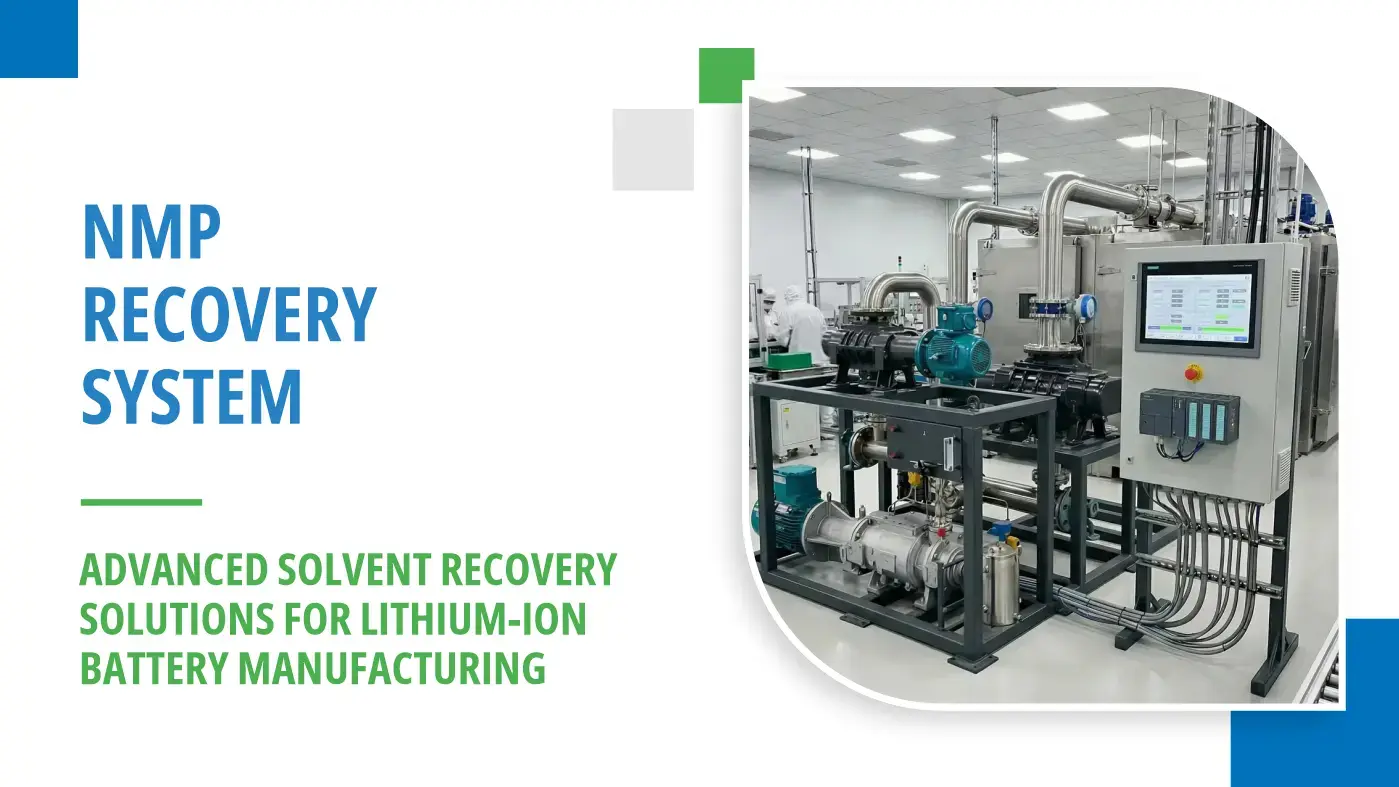
Battery manufacturing wastewater and process streams may contain dissolved inorganic salts, metal-bearing compounds, and other constituents. Evaporation may be considered for suitable wastewater concentration, selected high-TDS streams, water recovery, and RO reject treatment.
Engineering considerations: Composition varies with process and battery chemistry. Assess lithium and other dissolved metals, fluoride or aggressive constituents where present, pH, salts, suspended solids, scaling potential, condensate quality, and downstream residue management. Pretreatment may be essential.
6. Food and Dairy Processing Industry
MVR evaporation is used in suitable food and dairy processes to concentrate liquids, including:
- Milk and whey.
- Fruit juice and food extracts.
- Sugar solutions.
- Suitable process water streams for recovery.
During whey concentration, an MVR evaporator removes water while reusing the latent heat of generated vapour. The concentrated whey can then be dried or further processed.
The European Commission's Food, Drink and Milk Industries reference document describes vapour recompression as an energy-efficiency approach in food and milk processing.
Engineering considerations: Product viscosity, temperature sensitivity, protein deposition, foaming, and cleaning requirements influence equipment selection. Falling film systems may suit some low-viscosity, heat-sensitive products; other feeds may require different configurations.
7. Industrial Wastewater Treatment
MVR evaporation can support industrial wastewater treatment by concentrating high-TDS streams, recovering condensate, reducing wastewater volume, concentrating RO reject, and preparing brine for further treatment or salt recovery.
How Does MVR Support a Zero Liquid Discharge (ZLD) System?
A typical ZLD system may include the following stages:
- Pretreatment: Removes suspended solids, oil, hardness-causing compounds, and other contaminants that could affect downstream equipment.
- Reverse osmosis: Recovers a portion of the wastewater as permeate and produces a concentrated reject.
- MEE or MVR evaporation: Concentrates the reject and recovers water through vapour condensation.
- Crystallisation or ATFD: Processes concentrated brine into solid or semi-solid residue, depending on composition and system design.
- Solids management: Collects and manages residue for appropriate recovery or disposal.
A representative process flow is:
Pretreatment → RO → RO reject → MEE/MVR → concentrated brine → ATFD/crystalliser → solid residue
The final configuration depends on wastewater composition, water-recovery objectives, salt-recovery requirements, residue characteristics, and the intended reuse or disposal route. Explore ECOPROCESS Zero Liquid Discharge Solutions for integrated wastewater recovery and evaporation applications.
What Are the Key Operating Parameters Affecting MVR Performance?
MVR performance depends on thermodynamic conditions, compressor characteristics, heat-transfer efficiency, and feed properties.
|
Parameter |
Effect on MVR performance |
|
Evaporation rate |
Determines the quantity of vapour generated |
|
Temperature lift |
Influences compressor pressure ratio and power consumption |
|
Operating pressure |
Determines boiling temperature and vapour density |
|
Boiling point elevation |
Reduces the effective temperature difference for heat transfer |
|
Vapour flow rate |
Determines compressor capacity |
|
Heat-transfer coefficient |
Influences required heat-transfer area |
|
Feed concentration |
Affects viscosity, boiling behavior, and fouling |
|
Compressor efficiency |
Influences electrical energy consumption |
|
Scaling potential |
Affects heat-transfer performance and maintenance |
MVR vs MEE: Which Evaporation Technology Is Better?
MVR and Multi-Effect Evaporation (MEE) both improve thermal energy utilisation, but they recover heat differently.
|
Parameter |
MVR Evaporator |
MEE Evaporator |
|
Heat recovery |
Mechanical vapour compression |
Vapour reused across multiple effects |
|
Primary energy input |
Compressor electricity |
Heating steam, plus auxiliary electricity |
|
Compressor |
Required |
Generally not required |
|
Steam consumption |
Often lower in suitable applications |
Reduced through multiple-effect operation |
|
Electricity demand |
Relatively higher |
Generally lower compressor electricity demand |
|
Operating principle |
Compressed vapour is reused as heating medium |
Vapour from one effect heats the next |
|
Typical application |
Continuous evaporation and water recovery |
Large evaporation duties and steam integration |
MVR shifts a significant part of the evaporation energy requirement from external steam to compressor electricity. Operating-cost advantages depend on electricity and steam tariffs, temperature lift, compressor efficiency, evaporation duty, and operating hours.
When Should Industries Select MVR?
MVR may be suitable when electricity costs compare favourably with steam, reusable vapour is available, and the required temperature lift can be achieved efficiently.
When Should Industries Select MEE?
MEE may be preferable when steam is readily available, electricity costs are high, or a large evaporation duty can be handled efficiently through multiple effects. Hybrid MEE-MVR or MEE-TVR configurations may also be evaluated.
The final selection should consider energy consumption, utility costs, capital investment, and lifecycle operating expenses.
What Technical Challenges Should Be Considered in MVR System Design?
Reliable MVR operation requires appropriate equipment selection and process engineering. Key considerations include:
- Scaling and fouling: Deposits on heat-transfer surfaces can reduce efficiency.
- Corrosion: Materials must suit the feed chemistry, including chlorides, acids, and alkalis.
- Compressor operating limits: Vapour flow, pressure ratio, temperature, and mechanical limits must remain within the specified operating envelope.
- Foaming and entrainment: Liquid carryover can affect compressor performance and condensate quality.
- Non-condensable gases: Air and other gases can reduce heat-transfer efficiency and may require venting.
- Electrical consumption: The economic benefit depends on local utility costs and operating conditions.
These factors should be assessed during process design, equipment selection, and pilot testing where necessary.
How Does ECOPROCESS Solutions Support Industrial Evaporation and MVR Applications?
ECOPROCESS Solutions provides industrial evaporation and process-engineering solutions for concentration, thermal energy recovery, and wastewater volume reduction. Its technology portfolio includes:
- Multi-Effect Evaporators (MEE).
- Mechanical Vapor Recompression (MVR) and Thermal Vapor Recompression (TVR).
- Falling Film and Rising Film Evaporators.
- Forced Circulation Evaporators.
- Wiped Film and Agitated Thin Film Evaporators.
- Integrated evaporation solutions for ZLD applications.
Application-Specific Evaporation System Design
Equipment selection considers feed composition, evaporation capacity, viscosity, scaling potential, operating pressure, temperature lift, and available utilities. ECOPROCESS supports process-specific configuration and integration, including thermal and utility assessment, wastewater-treatment integration, PLC/SCADA automation, custom-engineered systems, installation, commissioning, and lifecycle support.
Pilot Plant Testing Before Full-Scale Installation
Pilot testing with actual process material can help establish evaporation capacity, concentration performance, condensate quality, scaling and fouling behaviour, utility requirements, and scale-up parameters.
ECOPROCESS operates a pilot plant facility with evaporation, drying, distillation, and vacuum equipment for customer trials. Explore ECOPROCESS Industrial Evaporation Solutions to review available technologies and applications.
Frequently Asked Questions
1. What is Mechanical Vapor Recompression used for?
MVR is used for industrial liquid concentration, evaporation, process water recovery, and wastewater volume reduction in suitable chemical, pharmaceutical, agrochemical, textile, food, dairy, and wastewater applications.
2. How does an MVR evaporator save energy?
It compresses secondary vapour, increasing its pressure and saturation temperature, then reuses the vapour as a heating medium to recover latent heat and reduce fresh steam demand.
3. What industries use MVR evaporators?
Chemical, pharmaceutical, agrochemical, textile, battery, food and dairy, and industrial wastewater treatment facilities may use MVR where process conditions are suitable.
4. What is the role of a compressor in an MVR system?
The compressor raises the pressure and saturation temperature of generated vapour, enabling it to transfer heat back to the evaporator.
5. Can MVR be used for high-TDS wastewater?
Yes, for suitable streams. Boiling point elevation, scaling, corrosion, condensate quality, and downstream brine management must be evaluated.
6. How do I select the right industrial MVR evaporator?
Selection depends on feed composition, evaporation capacity, temperature lift, vapour properties, scaling potential, condensate quality, utilities, and operating economics. A process and energy assessment is recommended.
Conclusion
Mechanical Vapor Recompression is an energy-recovery technology for industrial concentration, evaporation, and water recovery. By reusing the latent heat of generated vapour, MVR can reduce external steam requirements in suitable applications.
Successful implementation depends on compressor selection, temperature-lift optimisation, heat-transfer design, feed pretreatment, and control of scaling and fouling. A process assessment helps determine whether MVR, MEE, or a hybrid configuration is appropriate.
ECOPROCESS Solutions provides evaporation technologies and process-engineering capabilities for concentration, water recovery, and wastewater treatment. Visit ECOPROCESS Industrial Evaporation Systems or explore Zero Liquid Discharge Solutions.