NMP Recovery System for Lithium-Ion Battery Manufacturing: Process, Equipment & Technology
Lithium-ion battery manufacturing requires efficient solvent management, particularly during cathode coating and electrode drying. N-Methyl-2-Pyrrolidone (NMP) is used to dissolve the PVDF binder and prepare cathode slurry. During electrode drying, this solvent evaporates and leaves with the exhaust air.
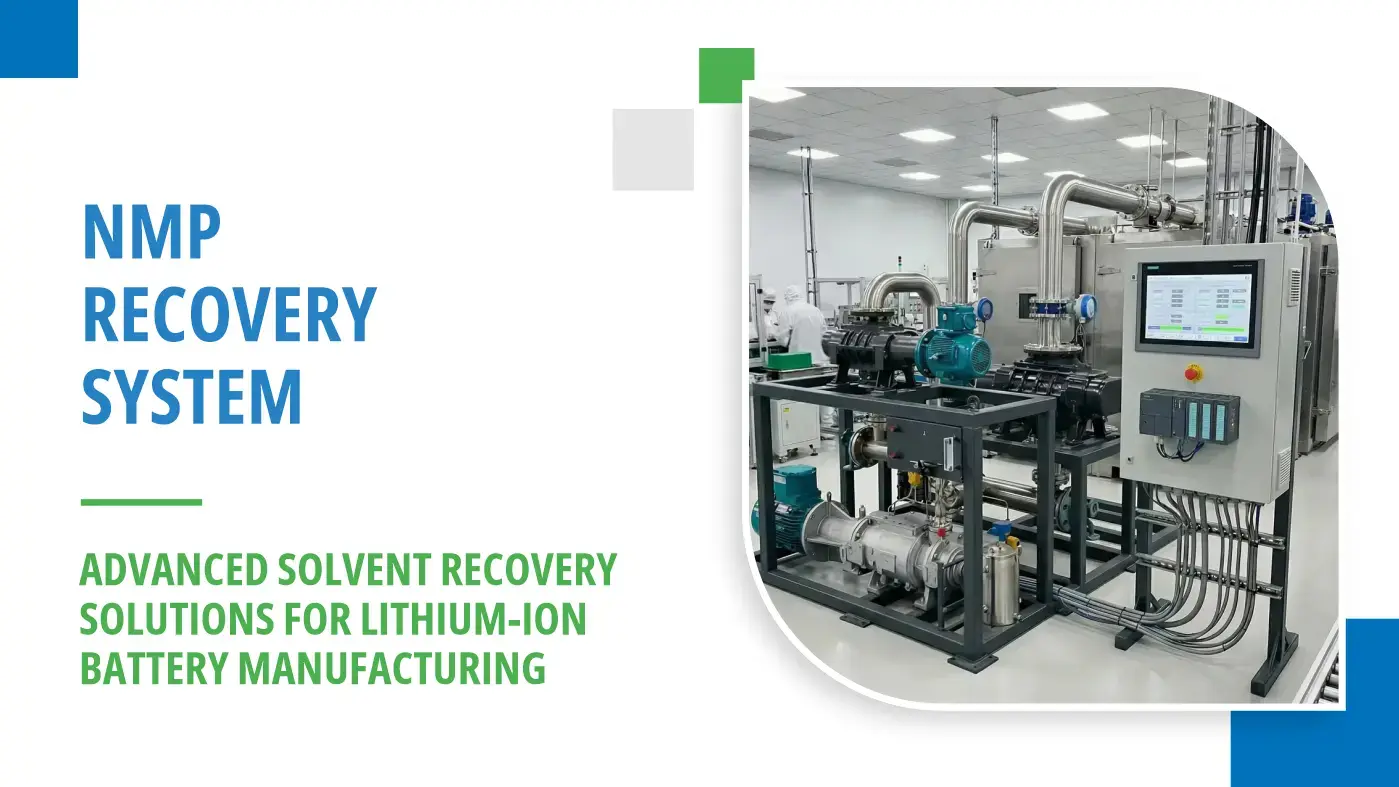
An NMP recovery system captures this solvent, separates it from the exhaust, and purifies it for potential reuse. An integrated system may include heat recovery, condensation, adsorption, distillation, and industrial vacuum technology.
For battery manufacturers, the objective is not simply to collect NMP but to reduce fresh solvent consumption, manage emissions, and maintain the quality required for reuse.
NMP handling also requires appropriate workplace safety measures because exposure to this solvent can pose health risks. The US Environmental Protection Agency's NMP risk evaluation provides further information about the potential health effects associated with NMP exposure.
What Is an NMP Recovery System?
An NMP recovery system is an industrial solvent recovery arrangement that captures NMP vapour generated during cathode coating and electrode drying.
During production, cathode slurry containing NMP is applied to an aluminium current collector. The coated electrode passes through a drying oven, where heat evaporates the solvent. The resulting NMP-containing exhaust is directed to a recovery plant.
The system captures the solvent through condensation and, where required, adsorption. The recovered liquid may undergo further purification to remove water and other impurities before reuse.
Recovery efficiency depends on exhaust airflow, NMP concentration, temperature, moisture content, equipment configuration, and operating conditions. Any quoted recovery percentage should specify its measurement boundary and test conditions.
How Does the NMP Recovery Process Work?
The typical process involves multiple stages:
Electrode Coating → Drying Oven → NMP Exhaust → Heat Recovery → Condensation → Adsorption (if required) → Solvent Collection → Purification → Storage → Reuse
1. Electrode Drying and Exhaust Collection
NMP evaporates when the coated electrode passes through the drying oven. Exhaust ducting collects the solvent-bearing air and transfers it to the recovery plant.
2. Heat Recovery
Heat exchangers transfer thermal energy from the hot exhaust to incoming process air. This can reduce fresh heating requirements, depending on temperature differences and heat exchanger performance.
3. NMP Condensation
The exhaust is cooled through heat exchangers and condensers. Part of the NMP vapour condenses into liquid and is collected in storage tanks.
4. Adsorption and Solvent Concentration
A zeolite rotor or suitable adsorption system may capture residual NMP remaining after condensation. Controlled heating during desorption releases the captured solvent into a concentrated stream for further cooling and collection.
Condensation and adsorption are complementary technologies in many configurations. Zeolite rotor selection depends on exhaust composition, humidity, NMP loading, airflow, and desorption conditions.
5. Solvent Purification and Reuse
Recovered NMP may contain water and other contaminants. A suitable purification process, potentially involving distillation, is selected according to feed composition and required solvent quality. After testing, the purified solvent can be stored for reuse.
How Do Electrode Drying Conditions Affect NMP Recovery System Design?
The recovery plant must be sized using actual exhaust conditions and production requirements rather than nominal NMP consumption alone.
Important engineering parameters include:
- Exhaust airflow: Actual and maximum airflow from each electrode drying line.
- NMP concentration: Average and peak solvent concentration in the exhaust.
- Exhaust temperature: Normal operating temperatures and fluctuations.
- Moisture content: Humidity and water vapour affecting condensation and adsorption.
- Production variation: Changes in NMP loading during start-up, shutdown, and production.
- Number of coating lines: Combined airflow and solvent loading from connected lines.
- Pressure drop: Resistance across ducting, heat exchangers, condensers, and adsorption equipment.
These parameters influence equipment sizing, fan selection, cooling requirements, and overall recovery performance.
|
Design parameter |
Information required |
Why it matters |
|
Exhaust airflow |
Actual and maximum airflow per line |
Determines equipment capacity |
|
NMP concentration |
Average and peak concentration |
Establishes solvent loading |
|
Exhaust temperature |
Normal and fluctuating temperatures |
Affects heat recovery and condensation |
|
Moisture content |
Relative humidity or water vapour loading |
Influences condensation and adsorption |
|
Number of coating lines |
Existing and planned lines |
Determines combined system capacity |
|
Operating schedule |
Hours per day, shifts and production pattern |
Helps establish average and peak loading |
|
Pressure drop |
Allowable pressure drop across the system |
Affects fan and duct design |
|
Solvent consumption |
Daily or annual NMP consumption |
Helps establish recovery targets and mass balance |
NMP Purification and Distillation for Battery-Grade Reuse
Recovering NMP does not automatically make it suitable for cathode slurry preparation. The collected solvent must meet the manufacturer's reuse specifications.
Important purification considerations include:
- Water removal: Evaluate moisture content in recovered NMP and establish the required final water specification.
- Impurity separation: Identify contaminants through feed analysis and select suitable separation methods.
- Solvent quality: Check NMP purity, water content, and other application-specific parameters.
- Distillation selection: Choose equipment based on feed composition, separation requirements, and product specifications.
NMP and water exhibit complex vapour-liquid equilibrium, including azeotropic behaviour. Therefore, conventional distillation may not always achieve the required water specification. The purification arrangement must be selected using appropriate separation data and process evaluation.
|
Parameter |
What needs to be evaluated |
|
NMP purity |
Required purity for reuse in cathode slurry preparation |
|
Water content |
Maximum acceptable moisture |
|
Other impurities |
Contaminants identified through feed analysis |
|
Feed composition |
Composition of collected NMP from the recovery plant |
|
Separation method |
Distillation or other suitable purification arrangement |
|
Product testing |
Verification against the battery manufacturer's specification |
NMP recovery efficiency and purified solvent yield are not the same measurement. A system may capture a high percentage of NMP from exhaust, but the quantity of purified NMP suitable for reuse will also depend on purification losses and product-quality requirements.
Where Are Vacuum Systems Used in NMP Recovery and Purification?
Vacuum technology may be used in selected NMP distillation and purification applications where reduced-pressure operation supports the required separation or thermal conditions.
A vacuum system may include:
- Industrial vacuum pumps are selected according to operating pressure and gas load.
- Condensers for handling condensable process vapours.
- Separators and upstream protection for vacuum equipment.
- Pressure measurement instruments, valves, and automated controls.
Vacuum is not mandatory in every NMP recovery plant. Its requirement depends on the purification process, vapour composition, operating temperature, and separation objectives.
Engineering Considerations for Vacuum-Assisted NMP Distillation
- Required operating pressure.
- Vapour load and composition.
- Condensable vapour handling.
- Condenser and separator arrangement.
- Compatibility of wetted materials with the process stream.
- Upstream protection and condensate management.
- Integration with pressure instrumentation and process controls.
The vacuum package will be selected based on the calculated gas load and required pressure range.
Main Equipment Used in an Industrial NMP Recovery Plant
|
Equipment |
Main function |
|
Heat exchanger |
Exhaust heat recovery |
|
Condenser |
NMP vapour condensation |
|
Zeolite rotor / adsorption unit |
Residual solvent capture |
|
Desorption heater |
Solvent release from adsorption media |
|
Collection tanks |
Recovered solvent storage |
|
Distillation system |
Solvent purification |
|
Vacuum pumps |
Reduced-pressure operation where required |
|
Process pumps |
Solvent transfer |
|
PLC / SCADA |
Process monitoring and automation |
The final equipment scope should be determined through integrated process engineering rather than selecting individual components independently.
What Should You Check Before Selecting an NMP Recovery System?
Before finalising an industrial NMP recovery plant, evaluate the following parameters:
|
Selection parameter |
Engineering requirement |
|
Exhaust airflow |
Actual and maximum airflow |
|
NMP loading |
Average and peak concentration |
|
Temperature |
Normal range and variations |
|
Moisture |
Humidity and water vapour |
|
Recovery target |
Overall recovery and measurement boundary |
|
Solvent quality |
Purity, water content, and impurity limits |
|
Production capacity |
Coating throughput and operating hours |
|
Utilities |
Electricity, heating, cooling water, and compressed air |
|
Installation |
Floor space, duct routing, and plant layout |
|
Safety |
Containment, ventilation, and monitoring |
|
Expansion |
Provision for additional coating lines |
For an accurate technical RFQ, manufacturers should also provide exhaust composition, operating schedules, solvent consumption, required reuse specifications, utility availability, and start-up and shutdown conditions.
Recovery efficiency should be evaluated using a defined mass balance:
NMP Recovery Efficiency (%) = (Mass of NMP recovered ÷ Mass of NMP entering the defined system boundary) × 100
Exhaust-side capture efficiency and final purified solvent yield should be assessed separately where applicable.
NMP recovery process follows:
- NMP entering the defined exhaust recovery boundary.
- NMP captured in the recovery system.
- NMP lost or remaining in the treated exhaust.
- NMP sent for purification.
- Purified NMP meeting the reuse specification.
- Purification losses and rejected material.
(Any actual ECOPROCESS performance figure should be supported by test data and a clearly defined measurement boundary.)
Plant Layout and Utility Requirements for an NMP Recovery System.
|
Area |
Details to cover |
|
Exhaust ducting |
Connection from electrode drying ovens to the recovery plant |
|
Heat recovery |
Heat exchanger arrangement and thermal integration |
|
Condensation section |
Condensers, cooling medium and collection tanks |
|
Adsorption section |
Rotor/adsorption equipment and desorption heating, if applicable |
|
Purification section |
Distillation equipment and associated process systems |
|
Solvent storage |
Recovered and purified NMP storage and transfer |
|
Utilities |
Electricity, heating, cooling water and compressed air, as applicable |
|
Installation |
Floor space, equipment access, duct routing and maintenance clearance |
|
Safety |
Containment, ventilation, leak monitoring and applicable site safety provisions |
(These depend on airflow, NMP loading, recovery configuration, purification duty and site conditions.)
NMP Recovery System for New Battery Plants and Existing Production Lines
New installations: Design the recovery plant around the planned coating line capacity, exhaust conditions, future expansion and required solvent quality.
Existing plant upgrades: Evaluate current recovery performance, exhaust loading, pressure drop, cooling capacity, adsorption performance, solvent quality and energy consumption before recommending modifications.
|
Cost factor |
What to evaluate |
|
Fresh NMP consumption |
Annual solvent purchase cost |
|
Solvent recovery |
Quantity of NMP captured |
|
Purification yield |
Quantity meeting reuse specifications |
|
Electricity |
Fans, pumps and other electrical equipment |
|
Heating |
Thermal energy for desorption and purification, if applicable |
|
Cooling |
Cooling water or chilled-water demand |
|
Maintenance |
Filters, adsorption media and equipment maintenance |
|
Waste handling |
Treatment and disposal of unrecovered or rejected solvent |
Industrial NMP Recovery and Solvent Purification Solutions from ECOPROCESS
Lithium-ion battery manufacturing requires reliable solvent recovery and purification systems to manage NMP generated during cathode electrode drying.
ECOPROCESS Solutions approaches NMP recovery as an integrated industrial process engineering requirement, covering exhaust treatment, solvent separation, purification, and process integration.
Depending on project requirements, the engineering and equipment scope may include:
- Industrial NMP solvent recovery systems.
- Heat exchangers and NMP condensation systems.
- Zeolite rotor and adsorption arrangements, where suitable.
- Solvent collection and handling systems.
- NMP purification and distillation units.
- Industrial vacuum systems for suitable applications.
- Process instrumentation and PLC/SCADA automation.
ECOPROCESS also offers pilot plant facilities to support process evaluation and engineering studies, subject to application requirements. Pilot evaluation can help assess feed characteristics, separation requirements, and suitable process configurations before full-scale implementation.
The final system design and expected performance are established based on actual exhaust conditions, solvent composition, recovery targets, utility requirements, and final product specifications.
Planning a new battery manufacturing line or upgrading an existing NMP recovery plant? Contact ECOPROCESS Solutions to discuss your process requirements and integrated recovery solutions.
Frequently Asked Questions
1. What is an NMP recovery system in lithium-ion battery manufacturing?
It is an industrial system that captures NMP vapour from cathode electrode drying exhaust, recovers the solvent, and purifies it for potential reuse.
2. What recovery rate can an NMP recovery plant achieve?
Recovery performance depends on exhaust conditions, equipment configuration, and measurement boundaries. Claims above 98% should be validated against actual operating conditions and a defined mass balance.
3. Why are condensation and adsorption used together?
Condensation captures NMP by cooling the exhaust, while adsorption captures residual solvent that remains in the air stream. Their combination depends on the required recovery target.
4. Can recovered NMP be reused in cathode slurry preparation?
Yes, provided it meets the manufacturer's required purity, water content, and impurity specifications after appropriate purification and quality testing.
5. Is vacuum distillation necessary for NMP purification?
Not always. Vacuum distillation may be used where reduced-pressure operation supports the required separation and thermal conditions.
6. Does an NMP recovery system reduce manufacturing costs?
It can reduce fresh NMP purchases and solvent-related waste. The overall financial benefit depends on solvent recovery, purification yield, energy consumption, maintenance, and operating costs.
Conclusion
An NMP recovery system for lithium-ion battery manufacturing helps capture solvent from electrode drying exhaust, recover reusable NMP, and manage solvent-related emissions.
The right solution requires coordinated engineering of heat recovery, condensation, adsorption, purification, and vacuum technology where necessary. Exhaust conditions, solvent quality, energy balance, and production capacity must all be considered during system selection.
ECOPROCESS Solutions provides industrial NMP recovery and process integration solutions, helping manufacturers evaluate the complete process from exhaust collection to solvent purification and reuse.
Need an NMP recovery solution for your battery manufacturing plant?
Contact ECOPROCESS Solutions to discuss your process requirements and engineering scope.