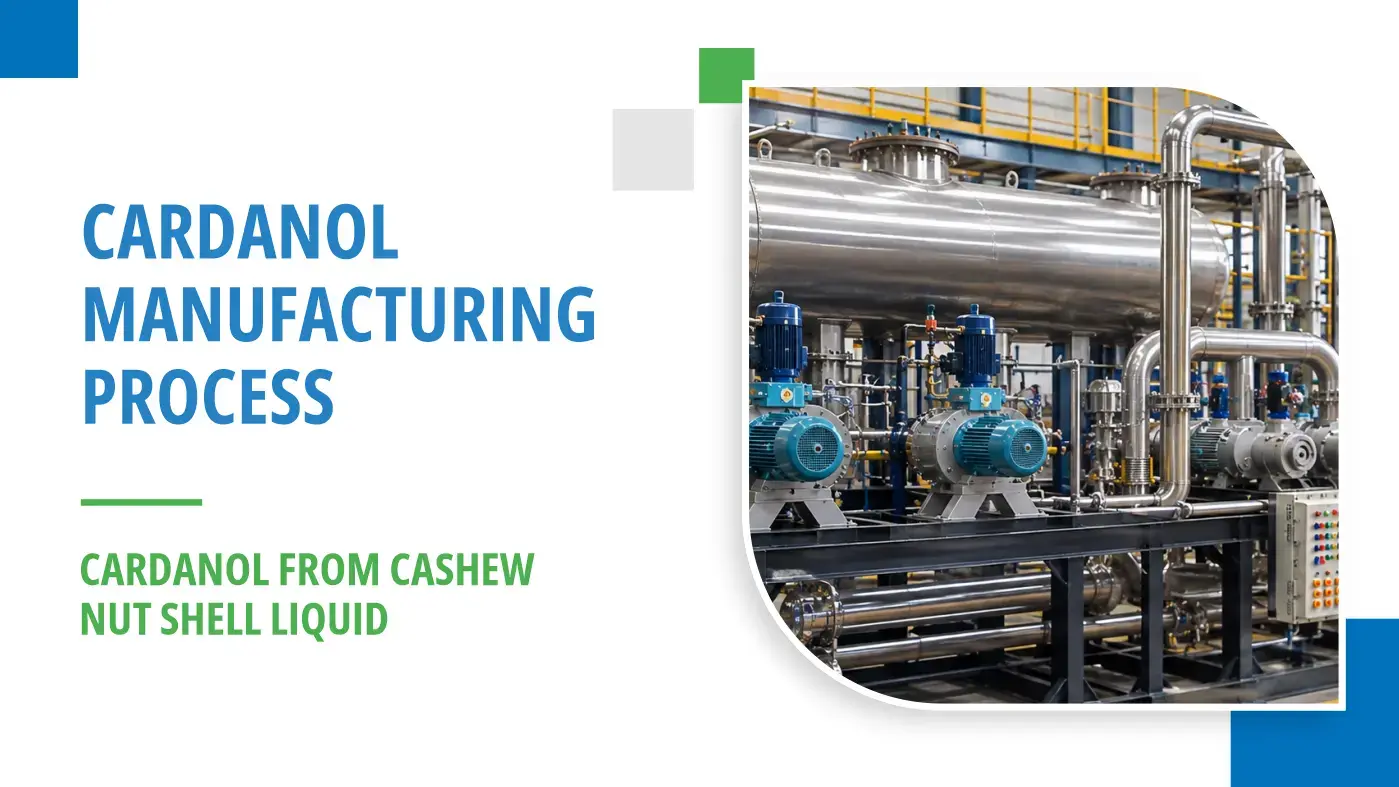
Cardanol Manufacturing Process: From Cashew Nut Shell Liquid to Industrial Applications
Cardanol is a renewable, bio-based phenolic compound derived from Cashew Nut Shell Liquid (CNSL), a valuable by-product of the cashew processing industry. It is used as a raw material for manufacturing specialty resins, industrial coatings, adhesives, epoxy curing agents and other chemical products.
The Cardanol Manufacturing Process involves processing CNSL through suitable thermal treatment, separation, and purification stages. Depending on the type of CNSL used, controlled thermal decarboxylation may convert anacardic acid into cardanol, followed by separation of the cardanol-rich fraction using suitable processing technologies.
Understanding the Cardanol Production Process helps manufacturers evaluate feed characteristics, select appropriate distillation equipment, and establish the processing conditions required to achieve the desired product quality. This article explains the major manufacturing stages, equipment requirements, and industrial applications of cardanol.
What Is Cardanol and Cashew Nut Shell Liquid (CNSL)?
Cashew Nut Shell Liquid (CNSL) is a reddish-brown viscous liquid obtained from the shells of cashew nuts (Anacardium occidentale). It contains naturally occurring phenolic compounds, including anacardic acid, cardanol, cardol, and related components.
Natural CNSL vs Technical CNSL
CNSL is generally classified into two types based on the extraction method and resulting chemical composition.
Natural CNSL: Obtained through low-temperature extraction methods, such as solvent extraction or mechanical processing. It generally contains a higher proportion of anacardic acid, along with cardol and smaller quantities of cardanol.
Technical CNSL: Produced through high-temperature processing, during which anacardic acid undergoes decarboxylation and converts into cardanol. As a result, technical CNSL generally contains a higher proportion of cardanol.
The composition of both types can vary depending on the cashew nut source and processing conditions. Therefore, feed analysis is important before selecting the downstream cardanol separation and purification process.
CNSL processing is particularly valuable because it converts an agricultural processing by-product into a renewable chemical feedstock.
How Is Cardanol Manufactured from Cashew Nut Shell Liquid?
The industrial Cardanol Manufacturing process generally involves CNSL procurement or extraction, feed preparation, thermal processing where required, vacuum distillation, condensation and product purification.
The exact sequence depends on whether natural or technical CNSL is used, its chemical composition and the required cardanol quality. In some cases, thermal decarboxylation takes place during the initial CNSL extraction or processing stage, while other feedstocks may require further thermal treatment before separation.
The following stages explain the complete Cardanol Production process.
1. Cashew Nut Shell Liquid Extraction
The first stage of Cardanol Extraction involves obtaining CNSL from cashew nut shells. Depending on the processing method, CNSL can be extracted through mechanical extraction, thermal processing, or solvent-based extraction.
The extraction method influences the chemical composition of the resulting CNSL. Low-temperature extraction generally preserves a higher proportion of anacardic acid, while high-temperature processing promotes its conversion into cardanol through decarboxylation.
The extracted CNSL is collected and transferred to suitable storage tanks before further processing. Feed composition and quality should be evaluated to determine the appropriate downstream treatment and separation requirements.
2. CNSL Preheating and Feed Preparation
Before entering the distillation system, CNSL is generally preheated to reduce viscosity and improve flow characteristics.
Feed preparation may also include filtration or other conditioning steps, depending on the raw material quality and process requirements.
Temperature, feed rate and transfer arrangements should be selected according to CNSL composition, viscosity and the design of the processing equipment. Consistent feed conditions help support stable downstream operation.
3. Thermal Processing and Decarboxylation
Thermal processing is an important stage when the incoming CNSL contains a significant proportion of anacardic acid.
During controlled heating, anacardic acid undergoes decarboxylation and converts into cardanol, increasing the cardanol content of the processed material.
The extent of this conversion depends on the initial CNSL composition and thermal processing conditions. Temperature and residence time must be evaluated carefully to avoid unnecessary thermal degradation and polymer formation.
For technical CNSL that has already undergone substantial thermal decarboxylation during extraction, the additional thermal treatment requirement may differ. Feed analysis should therefore guide the process configuration.
4. Vacuum Distillation of CNSL
Vacuum distillation is an important separation technology used in cardanol recovery and purification. By operating under reduced pressure, the process allows vaporisation at lower temperatures than would generally be required under atmospheric conditions. This can help limit excessive thermal exposure during the separation of cardanol from other CNSL components.
Depending on the feed characteristics, required product specifications and processing capacity, manufacturers may evaluate different separation technologies, including:
- Vacuum Distillation: Used for separating and recovering cardanol-rich fractions under reduced pressure.
- Short-Path or Molecular Distillation: May be considered for high-boiling materials requiring controlled thermal exposure and short vapour travel distances.
- Agitated Thin Film Evaporators (ATFE): Can be evaluated for suitable viscous or heat-sensitive materials where thin-film heat transfer and controlled residence time are important.
The selection of the appropriate technology depends on CNSL composition, feed viscosity, thermal stability, operating pressure, heat-transfer requirements and desired product quality.
Vacuum system performance, vapour handling, condenser configuration and residue management are also important considerations in designing an industrial cardanol recovery system.
Explore ECOPROCESS’s range of industrial vacuum systems designed for chemical processing and vacuum distillation applications.
5. Condensation and Cardanol Collection
After vaporization, during the distillation process, the vapour stream is directed towards a suitable condenser. Cooling allows the vapour to condense into liquid form, which is collected in product receivers or storage tanks.
The condenser arrangement and cooling requirements depend on vapour composition, operating pressure, temperature and process throughput.
The remaining non-distilled material is collected separately. This residue may contain cardol, polymeric substances and other heavier CNSL components, depending on the feed composition and separation conditions.
Proper condenser sizing, vacuum system configuration and residue handling are important for maintaining stable operation and supporting the required product recovery.
6. Product Purification and Quality Testing
The collected cardanol-rich fraction may require additional purification or further separation depending on the required product specifications and the performance of the initial distillation stage.
Product quality is evaluated using suitable analytical methods to determine whether the recovered material meets the requirements of its intended application.
Quality evaluation typically includes:
- Cardanol content and chemical composition
- Colour and appearance
- Viscosity
- Moisture content
- Cardol and other relevant impurity levels
- Relevant physical and chemical properties
The final product is stored in suitable containers or bulk tanks before dispatch to downstream industries.
Industrial Applications of Cardanol
Cardanol is used as a renewable phenolic raw material in several specialty chemical industries. Its phenolic structure and long unsaturated hydrocarbon side chain make it suitable for developing resins, coatings, adhesives, epoxy curing agents and other industrial formulations.
1. Paints and Industrial Coatings
Cardanol-based resins are used in protective coatings, industrial paints, and corrosion-resistant formulations.
Their chemical structure can contribute to adhesion, flexibility, water resistance, and resistance to harsh operating environments.
2. Epoxy Resins and Curing Agents
Cardanol derivatives, particularly phenalkamines, are used as epoxy curing agents.
These materials are suitable for protective coatings, industrial flooring, marine applications, and chemical-resistant surfaces.
3. Adhesives and Laminating Resins
Cardanol is used in the production of specialty adhesives and laminating resins.
Its flexible hydrocarbon chain can help improve toughness and reduce brittleness in selected resin formulations.
4. Friction Materials
Cardanol-based resins are used in friction materials, including brake linings and industrial friction components.
Their thermal and mechanical properties make them useful in formulations requiring durability and resistance to wear.
5. Rubber and Specialty Chemicals
Cardanol derivatives are also used in rubber compounding, surfactants, dispersants, and other specialty chemical formulations.
Research continues to explore cardanol-based materials for bio-based polymers, additives, and advanced industrial applications.
Why Is Cardanol Distillation Important in Cardanol Manufacturing?
Vacuum distillation is used in cardanol processing to support the separation and recovery of cardanol-rich fractions from CNSL under reduced-pressure conditions.
Its importance includes:
- Reduced Vaporisation Temperature: Operating under reduced pressure can lower the temperature required for vaporisation.
- Thermal Exposure Management: Suitable vacuum operation can help limit excessive thermal exposure of the processed material.
- Controlled Separation: Supports the separation of cardanol-rich fractions from other CNSL components.
- Process Configuration Flexibility: Different vacuum distillation and thin-film technologies can be evaluated according to feed characteristics and product specifications.
- Industrial Processing: Equipment configurations can be developed for different production capacities and process requirements.
For manufacturers processing viscous CNSL, vacuum performance, heat transfer, residence time, vapour handling, condenser design and residue management are important equipment-selection considerations.
What Equipment Is Required for a Cardanol Production Plant?
A Cardanol Production Plant requires a combination of raw material handling, thermal processing, separation, vacuum generation and product collection equipment.
Typical Cardanol Manufacturing Plant Equipment includes:
|
Equipment |
Application |
|
CNSL Storage Tanks |
Raw material storage |
|
Feed Pumps |
CNSL transfer and circulation |
|
Preheating Systems |
Feed temperature conditioning |
|
Thermal Processing Vessels |
Controlled thermal treatment and decarboxylation, where required |
|
Vacuum Distillation Equipment |
Cardanol separation and recovery |
|
Agitated Thin Film Evaporators |
Thin-film processing for suitable feed materials |
|
Short-Path Distillation Units |
Specialised separation applications, where suitable |
|
Condensers |
Vapour condensation |
|
Industrial Vacuum Pumps |
Maintaining the required operating pressure |
|
Vacuum Boosters |
Supporting higher-capacity vacuum applications, where required |
|
Product Collection Receivers |
Collection of condensed cardanol |
|
Residue Collection Systems |
Handling heavier fractions |
|
Instrumentation and Control Panels |
Process monitoring and control |
|
Product Storage Tanks |
Storage of recovered cardanol |
The final equipment configuration depends on CNSL composition, feed viscosity, production capacity, required cardanol quality, operating pressure and thermal characteristics.
Vacuum systems, distillation equipment, thin-film evaporators, condensers and associated process components must be evaluated together to achieve an appropriate process arrangement.
How ECOPROCESS Solutions Supports Industrial Processing and Vacuum Distillation
Efficient chemical processing requires the right combination of process equipment, thermal control, separation technology, and vacuum engineering. In applications such as cardanol production from Cashew Nut Shell Liquid (CNSL), equipment selection plays an important role in achieving effective separation, product quality, and process efficiency.
ECOPROCESS Solutions provides engineered industrial process equipment and vacuum systems for applications involving evaporation, concentration, drying, and chemical processing. Its solutions include vacuum systems, evaporators, Mechanical Vapour Recompression (MVR) systems, Multiple Effect Evaporators (MEE), and Agitated Thin Film Dryers (ATFD).
Depending on the application and project requirements, suitable equipment configurations may include:
- Industrial Vacuum Systems: Vacuum pumps and booster arrangements for processes requiring controlled reduced-pressure operation.
- Agitated Thin Film Evaporators: Thin-film processing equipment for suitable viscous and heat-sensitive materials.
- Distillation Equipment: Equipment configurations for separation and recovery applications.
- Condensation Systems: Supporting equipment for vapour condensation and product collection.
- Customized Process Packages: Integrated equipment arrangements developed around feed characteristics, production capacity and product requirements.
For processes involving heat-sensitive or high-boiling materials, vacuum technology can support operation at reduced temperatures by lowering the boiling point of the material. Appropriate equipment selection, vapour handling, heat transfer, condensation, and vacuum system configuration are important considerations when designing such processes.
For manufacturers exploring cardanol manufacturing plant equipment or upgrading existing CNSL processing operations, ECOPROCESS Solutions can help assess process requirements and identify suitable equipment configurations based on feed characteristics, operating conditions, throughput, and product specifications.
Frequently Asked Questions
1. What is the raw material used for cardanol manufacturing?
Cashew Nut Shell Liquid (CNSL), extracted from cashew nut shells, is the primary raw material used for cardanol manufacturing.
2. How is cardanol produced from CNSL?
Cardanol is obtained from CNSL through thermal decarboxylation of anacardic acid, where required, followed by suitable separation and purification processes.
3. Which equipment is required for a cardanol manufacturing plant?
Typical equipment includes CNSL storage tanks, feed pumps, preheaters, thermal processing vessels, vacuum distillation systems, Agitated Thin Film Evaporators, condensers, vacuum pumps, and product collection tanks.
4. What are the major industrial applications of cardanol?
Cardanol is used in industrial coatings, epoxy curing agents, adhesives, laminating resins, friction materials, rubber compounding, and specialty chemicals.
5. Why is vacuum distillation used in cardanol production?
Vacuum distillation helps reduce vaporization temperatures, improve separation, and recover cardanol while limiting excessive thermal exposure of the processing material.
6. What are the advantages of using CNSL for cardanol production?
CNSL is a renewable raw material that converts cashew waste into valuable cardanol for resins, coatings, adhesives, and specialty chemicals.
7. Can an Agitated Thin Film Evaporator be used for cardanol recovery?
An Agitated Thin Film Evaporator may be considered for suitable CNSL processing applications involving viscous or heat-sensitive materials. Its suitability depends on feed composition, separation requirements, operating conditions and desired product quality.
8. What factors affect cardanol recovery and product quality?
Important factors include CNSL composition, anacardic acid and cardanol content, feed viscosity, thermal stability, operating pressure, heat transfer, residence time and separation equipment configuration.
Conclusion
The Cardanol Manufacturing Process demonstrates how Cashew Nut Shell Liquid can be transformed into a valuable industrial chemical through thermal processing, vacuum distillation, condensation, and purification.
As industries increasingly explore renewable raw materials, cardanol offers opportunities for developing bio-based coatings, resins, adhesives, epoxy curing agents, and specialty chemicals.
With appropriate process engineering and equipment selection, CNSL Processing can support efficient cardanol recovery and help utilize agricultural by-products in industrial manufacturing.
For businesses exploring cardanol recovery, Cardanol Production Plant development, or industrial vacuum distillation systems, understanding the complete manufacturing process is an important step towards developing an efficient production facility.
Optimise your CNSL processing and cardanol production with engineered industrial evaporation, distillation and vacuum systems. ECOPROCESS Solutions offers customised process equipment designed around your feed characteristics, production capacity and separation requirements.
Contact ECOPROCESS Solutions today to discuss your industrial processing requirements.