Used Oil Recycling Plant: Technology, Process, Benefits and Cost for Sustainable Oil Recovery
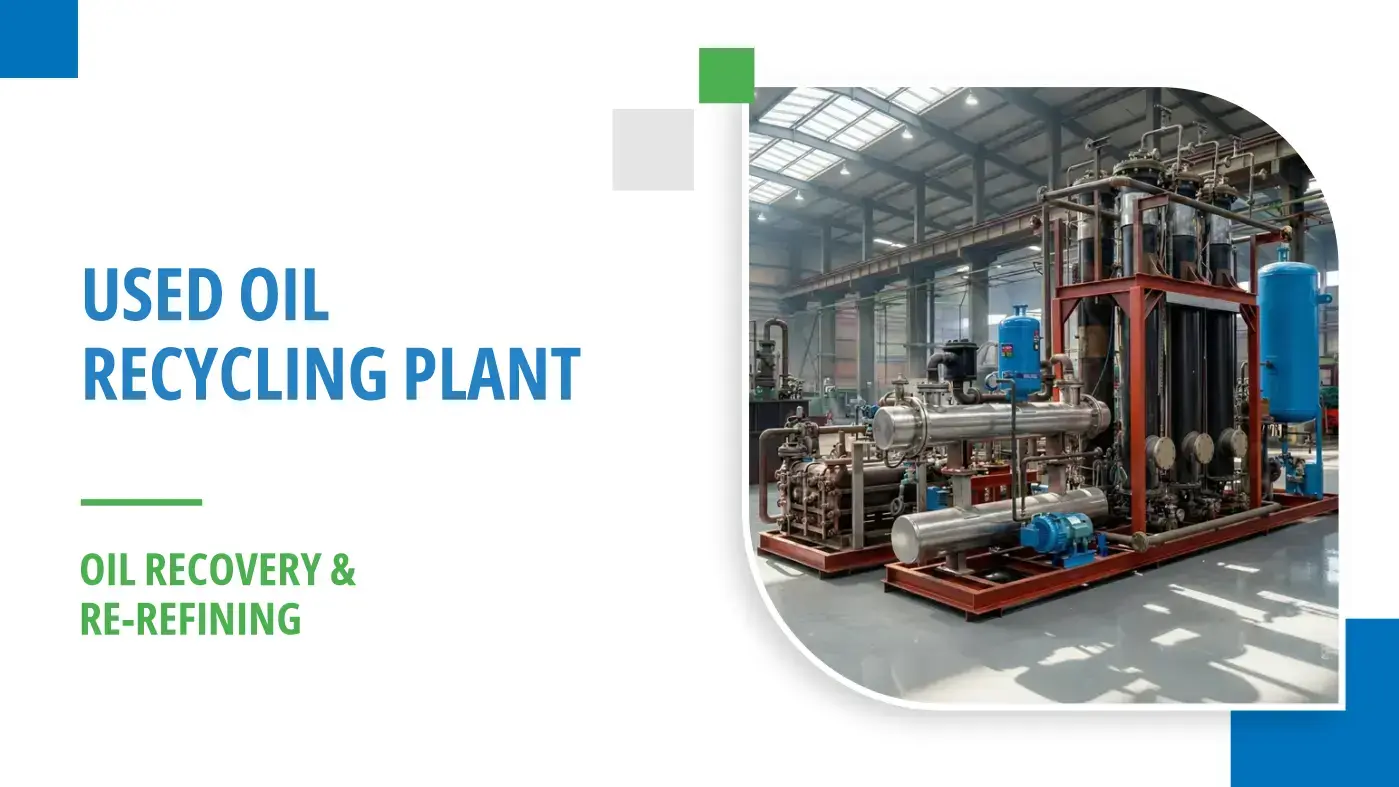
Used oil is not simply a waste product. With the right treatment technology, it can become a valuable secondary resource for recovering hydrocarbons and producing re-refined base oil and other usable fractions. A modern used oil recycling plant is designed to remove water, solids, additives, degraded compounds, and other contaminants while recovering useful oil fractions for further processing.
Used oil recycling, oil recovery and used oil re-refining are related but not identical concepts.
Recycling is the broader process of recovering value from used oil. Oil recovery may involve separation and treatment to obtain usable hydrocarbon fractions, while re-refining involves more extensive purification and processing intended to produce base-oil feedstock or other defined products. The appropriate process depends on feedstock characteristics and the required final product specification.
For industries, recyclers, automotive workshops, and waste-management operators, investing in used oil recycling can support resource recovery, reduce disposal requirements, and create a more circular approach to lubricant management. The US EPA states that used oil can be re-refined into lubricants, processed into fuel oils, or used as a raw material for petroleum-related industries.
“Used Oil Recycling Plant: Process at a Glance
Feedstock Testing → Filtration → Dehydration → Pre-Treatment → Vacuum Distillation → Thin-Film Separation → Fractionation/Purification → Product Testing → Storage”
How Does a Used Oil Recycling Plant Work?
A used oil recycling plant generally combines several treatment and separation stages. The exact configuration depends on the type and quality of incoming used oil and the required final product.
A typical used oil recovery or re-refining plant may combine several of the following stages. The actual sequence and equipment selection depend on feedstock composition, contaminants, target products, capacity and product-quality requirements.
Used Oil Collection → Feedstock Inspection & Testing → Pre-Filtration / Solid Removal → Dehydration / Water Removal → Pre-Treatment → Vacuum Distillation → Thin-Film / Wiped-Film Evaporation → Oil Fraction Separation → Further Purification / Hydroprocessing → Recovered Base Oil / Product → Cooling → Storage → Quality Testing
Not every plant requires every stage, and some processes may use solvent extraction, hydrotreatment or other purification technologies depending on the target product.
How to prepare used oil before the main treatment process?
Feed preparation is an important first step because used oil may contain water, dirt, metal particles, sludge, additives, and other contaminants.
The Process Includes:
|
Process Stage |
Primary Purpose |
Typical Contaminants / Parameters Addressed |
|
Feedstock testing |
Understand incoming oil characteristics |
Water, solids, viscosity, contaminants |
|
Filtration |
Remove suspended particles |
Dirt, sludge, metal particles |
|
Dehydration |
Remove free and emulsified water |
Moisture and water |
|
Pre-treatment |
Prepare oil for thermal separation |
Additives, contaminants and undesirable compounds |
|
Vacuum distillation |
Separate oil fractions |
Different boiling-range hydrocarbons |
|
Thin-film evaporation |
Improve separation under controlled conditions |
Heavy fractions and thermally sensitive components |
|
Purification |
Improve recovered oil quality |
Remaining undesirable compounds |
|
Product testing |
Verify final product characteristics |
Viscosity, quality and specification parameters |
Technology selection should be based on the actual feedstock rather than applying the same process to every waste-oil stream. Research reviewed by the US EPA describes technologies including vacuum distillation, solvent extraction, thin-film evaporation, and hydroprocessing for used oil re-refining.
How does vacuum distillation improve oil recovery?
Vacuum distillation allows separation at reduced pressure, helping lower the boiling temperatures required for separating different oil fractions. This can be particularly useful when the objective is to recover valuable hydrocarbon fractions while limiting excessive thermal exposure.
Vacuum distillation separates hydrocarbon fractions under reduced pressure, allowing the desired separation to be achieved at lower boiling temperatures than would generally be required at atmospheric pressure. This can help reduce thermal exposure of the feed during separation.
Modern systems may combine vacuum distillation with thin-film evaporation and downstream purification. The appropriate arrangement depends on feed composition, required product specifications, energy availability, and plant capacity.
In used oil re-refining applications, vacuum distillation can be integrated with pre-treatment, thin-film or wiped-film evaporation, fractionation and downstream purification. The vacuum system must be selected according to the required operating pressure, vapor load, condensable composition, non-condensable load and overall process configuration.
What Does a Used Oil Recycling Plant Cost and What Determines the Investment?
The investment required for a used oil recycling plant cannot be represented by a single standard price. The total project cost depends on several technical and commercial variables.
There is no technically meaningful “standard price” for a used oil recycling plant without defining the feedstock, processing capacity, process configuration and product specification. Two plants with the same nominal throughput can have substantially different equipment configurations and project costs because of differences in pre-treatment, vacuum requirements, purification, automation, utilities, environmental controls and residue handling.
Key Investment Factors for a Used Oil Recycling Plant
|
Investment Factor |
Impact on Project Economics |
|
Plant capacity |
Determines equipment size, throughput and potential production volume |
|
Feedstock availability |
Influences plant utilization and long-term operating continuity |
|
Feedstock quality |
Poor-quality feedstock may require additional pre-treatment |
|
Recovery yield |
Directly influences the quantity of saleable recovered product |
|
Technology selection |
Determines CAPEX, energy consumption and product quality |
|
Utility requirements |
Electricity, steam, thermal oil, cooling water and vacuum requirements affect OPEX |
|
Product specification |
Higher-quality products may require additional purification |
|
Automation |
Influences initial investment and operational control |
|
Environmental systems |
Required systems can increase CAPEX but support regulatory compliance |
|
Residue management |
Disposal or further treatment of sludge and residues adds operating costs |
|
Storage infrastructure |
Includes feedstock, intermediate and finished-product storage |
|
Maintenance |
Spare parts, servicing and equipment maintenance affect lifecycle cost |
In India, the regulatory environment has also become more structured. CPCB states that the Used Oil EPR framework came into force from April 1, 2024, with registered recyclers playing a role in used-oil recycling and used oil re-refining.
CAPEX considerations
-
process equipment
-
storage tanks
-
piping
-
electrical systems
-
instrumentation
-
automation
-
vacuum systems
-
utilities
-
civil works
-
environmental systems
-
installation and commissioning
OPEX considerations
-
feedstock acquisition
-
electricity
-
thermal energy
-
cooling
-
consumables
-
labour
-
maintenance
-
spare parts
-
residue handling
-
laboratory testing
-
transportation
A feasibility model should evaluate both CAPEX and recurring OPEX rather than comparing equipment quotations alone.
What financial data should be evaluated before investing?
A proper feasibility study should examine:
|
Parameter |
Why It Matters |
|
Used oil availability |
Determines whether the plant can operate consistently |
|
Feedstock purchase/collection cost |
Directly affects operating economics |
|
Processing capacity |
Determines potential throughput |
|
Oil recovery yield |
Influences saleable product volume |
|
Product selling price |
Determines potential revenue |
|
Energy consumption |
Affects recurring operating costs |
|
Labour and maintenance |
Contributes to OPEX |
|
Residue generation |
Influences disposal and treatment costs |
|
Logistics |
Impacts collection and product transportation |
|
CAPEX and financing |
Determines overall project economics |
Instead of evaluating the plant only on its equipment price, investors should calculate cost per tonne of feed processed, recovery yield, product value, operating cost, residue cost, and expected payback under realistic market conditions.
What Are the Main Deliverables in a Used Oil Recycling Project?
A properly engineered project should go beyond supplying individual machines. It should address the complete process from feed reception to recovered-product storage.
Typical project deliverables can include:
- Process flow diagram (PFD) and mass balance
- Piping & Instrumentation Diagram (P&ID)
- Feedstock characterization
- Technology selection
- Equipment specifications
- Heat and material balance
- Utility requirement calculations
- Equipment sizing
- Storage and transfer systems
- Vacuum system design
- Filtration and separation systems
- Pollution-control provisions
- Instrumentation and automation
- Electrical requirements
- Product-quality testing requirements
- Operation and maintenance documentation
The fundamentals of the project should be established through actual feedstock data. Laboratory testing of representative used oil can help determine water content, solids, viscosity, contaminants, distillation characteristics, and other parameters relevant to process design.
What Equipment Is Used in a Used Oil Recycling Plant?
|
Equipment |
Typical Role |
|
Feed storage tanks |
Receive and buffer collected used oil |
|
Filtration system |
Remove suspended solids and particulates |
|
Dehydration system |
Remove water from the feed |
|
Pre-treatment system |
Condition feed before thermal separation |
|
Vacuum distillation system |
Separate hydrocarbon fractions under reduced pressure |
|
Thin-film / wiped-film evaporator |
Support separation under vacuum with controlled thermal exposure |
|
Fractionation system |
Separate recovered fractions according to required specifications |
|
Condensers |
Condense recovered vapors |
|
Vacuum system |
Maintain required operating pressure |
|
Heat exchangers |
Provide heating/cooling and heat recovery |
|
Storage tanks |
Store recovered products and residues |
|
Instrumentation & automation |
Monitor and control process parameters |
|
Residue-handling system |
Manage heavy residues and process waste |
How Do You Determine Used Oil Recycling Plant Capacity?
Capacity should be determined from:
-
available feedstock
-
collection radius
-
operating days/year
-
expected plant utilization
-
feedstock variability
-
target product output
-
storage capacity
-
logistics
-
residue handling
-
utilities
Why Is Feedstock Testing Important Before Plant Design?
Used oil is not a uniform feedstock. Its composition can vary according to source, lubricant type, operating history, contamination and collection practices. Representative laboratory testing and, where appropriate, pilot-scale evaluation can therefore help establish the suitability of the proposed separation sequence before final equipment sizing and plant configuration.
What is the expected result of a properly designed recycling process?
The primary outcome is the recovery of usable oil fractions from a contaminated waste stream.
Depending on the selected technology and feedstock, the recovered material may be further processed into re-refined base oil or other commercially useful fractions. EPA notes that used oil re-refining can return used oil to the lubricant-production cycle and can reduce the need for virgin oil resources.
This outcome is useful for businesses looking to establish a circular resource model, reduce dependence on virgin petroleum-derived feedstocks, and create value from collected used oil.
What are the important features of a modern used oil recycling plant?
- Feedstock flexibility: Designed around the characteristics of the available used-oil stream.
- Efficient separation: Uses appropriate filtration, dehydration, distillation, and purification stages.
- Vacuum processing: Supports controlled separation of oil fractions.
- Heat integration: Can be designed to reduce unnecessary energy consumption.
- Automated controls: Helps monitor temperature, pressure, vacuum, flow, and other critical parameters.
- Residue management: Provides controlled handling of sludge and other process residues.
- Quality monitoring: Supports testing of recovered products against defined specifications.
- Scalable configuration: Can be engineered according to required processing capacity.
- Environmental controls: Incorporates appropriate systems for emissions, wastewater, spills, and waste handling.
How Does Used Oil Recycling Support Resource Conservation?
Used oil retains significant hydrocarbon value even after it has been removed from engines or industrial equipment. EPA reports that one gallon of used motor oil can provide approximately 2.5 quarts of lubricating oil when re-refined, compared with the 42 gallons of crude oil required to produce the same amount of virgin lubricating oil.
API describes re-refined used oil as a potential source of base stock for lubricating oils and notes that appropriately processed and formulated re-refined oils can meet relevant performance requirements.
The environmental value, however, depends on collection efficiency, processing technology, energy use, pollution controls, transportation, and the final disposition of recovered products. API's lifecycle work highlights that the benefits of different used-oil management routes can vary depending on these factors.
How ECOPROCESS Solutions Approaches Industrial Oil Recovery and Separation
ECOPROCESS Solutions provides engineered process equipment, vacuum technologies, and customized engineering requirements for applications involving separation, evaporation, distillation and resource recovery.
For used oil recovery and re-refining projects, the process configuration should be developed around the characteristics of the feedstock and the required product specification rather than treated as a fixed equipment package.
Depending on the application, the project may involve feed preparation, filtration, dehydration, vacuum distillation, thin-film evaporation, condensation, fractionation, purification, heat exchange, storage, instrumentation and automation.
ECOPROCESS Solutions' engineering approach can therefore be positioned around process evaluation, equipment selection and integrated system design, with particular relevance to applications requiring controlled vacuum, thermal separation and recovery of useful fractions.
The final configuration should be established through feedstock characterization, process design, equipment sizing, utility assessment and applicable environmental and regulatory requirements.
Why Is Used Oil Recycling Becoming an Important Circular-Economy Opportunity?
Used oil recycling connects waste management with resource recovery. Instead of treating used oil only as a disposal problem, used oil re-refining technologies can recover valuable hydrocarbon resources and return them to productive use.
For businesses considering a new plant, the most important step is not simply selecting a machine. It is developing a complete technical and financial model based on feedstock availability, recovery yield, product quality, energy consumption, residue management, regulatory requirements, and market demand.
A well-engineered used oil recycling plant can therefore become part of a broader circular-resource strategy while creating opportunities for recovered oil products and more controlled waste management.
Frequently Asked Questions
What is a used oil recycling plant?
A used oil recycling plant is an industrial facility that collects and processes contaminated or spent oil to recover usable oil fractions. Depending on the process configuration, the recovered material may be further refined into base oil or other useful products.
How is used oil recycled?
Used oil may undergo filtration, settling, dehydration, separation, vacuum distillation, thin-film evaporation, and further purification. The exact process depends on feedstock characteristics and the required final product.
Is used oil re-refining different from simply filtering used oil?
Yes. Filtration can remove certain suspended contaminants, while used oil re-refining involves more extensive separation and purification to recover suitable base-oil fractions. EPA identifies re-refining as a process that removes impurities so used oil can become a base stock for new lubricating oil.
What are the advantages of a used oil recycling plant?
Key advantages include resource recovery, reduced disposal requirements, recovery of valuable hydrocarbons, potential production of re-refined oil products, and support for circular use of petroleum resources.
What affects the investment required for a used oil recycling plant?
Capacity, feedstock quality, technology selection, product specifications, utilities, automation, environmental controls, land, storage, regulatory requirements, and operating conditions all affect the investment.
Can used oil be converted into base oil?
Yes. Properly designed re-refining processes can convert suitable used oil into recovered base-oil fractions. Additional purification or hydroprocessing may be required depending on the target quality.
How much does a used oil recycling plant cost?
The investment varies according to processing capacity, feedstock quality, process configuration, product specification, utilities, automation, environmental systems, storage and site requirements. A meaningful project estimate requires a defined process basis and technical specification rather than a generic plant price.
What is the difference between a used oil recycling plant and a used oil re-refining plant?
Used oil recycling is a broader term covering processes that recover value from used oil. Re-refining generally refers to more extensive processing intended to produce base-oil feedstock or other defined refined products. The terminology and process configuration can vary by application and regulatory framework.
Conclusion
A used oil recycling plant can convert waste oil into valuable recovered oil and hydrocarbon products. Consistent recovery and product quality depend on selecting the right process based on feedstock characteristics, recovery requirements, utilities, residue management, and environmental standards.
A well-designed system may combine pre-treatment, filtration, vacuum distillation, wiped-film evaporation, fractionation, purification, and vacuum technology for efficient oil recovery.
ECOPROCESS Solutions provides application-specific solutions for waste oil recovery, vacuum distillation, evaporation, separation, and industrial vacuum systems, helping businesses develop efficient and reliable recycling and used oil re-refining processes.
With the right technology and engineering approach, used oil can become a valuable industrial resource and support a circular-economy strategy.